Policy Fellowships in Washington, D.C.
Year One in Pittsburgh, Year Two in D.C.—on the job.
A defining feature of the Washington, D.C., track of the Master of Science in Public Policy and Management program is the required second-year Heinz Policy Fellowship, during which students work 30-plus hours per week while taking evening and Friday classes. Fellowships are hosted by public, private and nonprofit organizations, giving students the chance to apply their skills in fast-paced, high-impact environments.
This year’s D.C. cohort is advancing work across sectors, including city government, federal agencies, research, technology, and national associations. Each student brings a unique perspective, shaped by their Heinz coursework and professional experience, translating data-driven insights into meaningful public impact
Meet a few of the MSPPM–D.C. students and learn about their second-year fellowships, relevant Heinz course skills they are utilizing, and advice for prospective and first-year students.

Grace Berry
Undergraduate Institution: Brandeis University, Economics major with a minor in Mathematics
Fellowship: City of Alexandria, Virginia
Grace is completing her fellowship with the City of Alexandria’s Office of Performance Analytics. The office works to make City data more centralized, transparent and accessible by supporting departments in using data to inform decisions and improve public services. In this role, she is learning how decisions and priorities are shaped on a local level and how to best collaborate with a wide range of City stakeholders to integrate technology and analytical tools into their day-to-day work.
The combination of data- and evaluation-focused coursework, paired with classes on writing and presentation, has been invaluable in preparing for this experience. She notes that these courses have taught her how to turn data and analysis into insights that people can easily understand and act upon.
Her advice to prospective and first-year students is to take advantage of opportunities to apply what they learn outside the classroom early on—through internships, research or other projects. These experiences not only strengthen technical and communication skills but also help students see the real-world impact of their work.
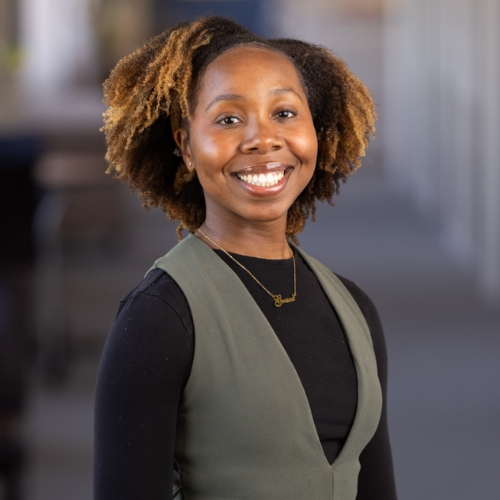
Grace Castelin
Undergraduate Institution: University of Central Florida, Political Science major (American Politics and Policy Track) with a minor in Sociology
Fellowship: Aspen Institute
Grace is a Graduate Fellow with the Benefit Transformation Initiative at the Aspen Institute’s Financial Security Program. In her role, she supports person-centered approaches and collaboration with state administrators and financial industry leaders to develop innovative solutions for evolving benefit systems. Working to reform social safety net programs during this critical period has strengthened her commitment to advancing economic justice for communities often excluded from financial prosperity.
Through this fellowship, Grace has learned the importance of convening diverse stakeholders to build common-ground strategies that enhance financial security. She has enjoyed using data visualization tools like Tableau, skills gained from her Telling Stories with Data course, to highlight financial shocks gathered from community expertise. She also hopes to apply her econometric and R analysis skills to assess state-level impacts and inform policy solutions, eventually contributing to a written piece.
Grace advises first-year and prospective students to remain open to exploring different policy areas to discover their niche and to understand intersections across the field. She emphasizes the importance of grounding routines to stay connected to one’s purpose and authenticity amid D.C.’s fast pace. She encourages students to bring their unique experiences into their work and take initiative in attending conferences and networking opportunities throughout the city.
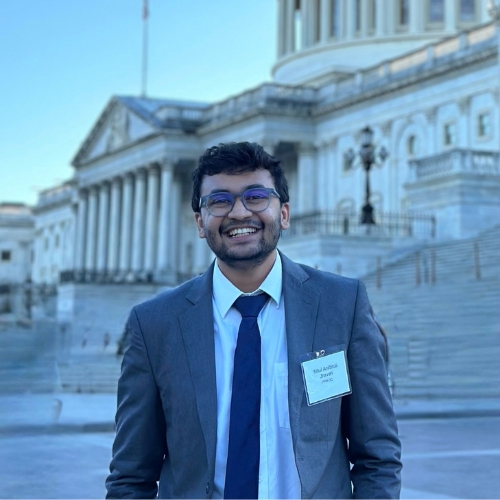
Mitul jhaveri
Undergraduate Institution: Nirma University, Bachelor of Technology in Instrumentation and Control
Fellowship: The World Bank
Mitul is currently working with the World Bank’s GovTech team within the Global Governance Practice, where he supports governments in modernizing digital systems, strengthening data governance, and advancing AI readiness. His work focuses on developing the Digital Fiscal Stack—a governance and design architecture for public financial management systems—and designing and implementing a Data Analytics Readiness Assessment for a national treasury. This work builds on his earlier experience with India’s Ministry of Health, where he contributed to digital health and administrative data systems for service delivery.
Working with multiple countries has given Mitul valuable insights into digital government design, which he hopes to bring back to India. Courses at Heinz, such as Management Science, Health Care Information Systems, and Geographic Information Systems, have been instrumental in shaping his approach to country-level assessments and analytics work.
Mitul’s advice to prospective or first-year students is to build a niche early, write and publish extensively on their area of interest, and network intentionally. He recommends participating in hackathons, attending conferences, and showcasing one’s work, emphasizing that targeted networking supported by tangible or published projects is highly effective. Looking back, he notes that he would have liked to take additional technical and quantitative courses to further complement his policy and management studies.

Aiyana Rockwell
Undergraduate Institution: Grinnell College, Economics major with a concentration in Policy Studies and Education
Fellowship: U.S. Government Accountability Office
Aiyana is currently a Graduate Analyst Intern at the U.S. Government Accountability Office (GAO) on their Financial Markets and Community Investment team, where she is performing a review of the private credit market. This past summer, she interned at the Federal Reserve Board’s Division of Monetary Affairs, supporting their strategic planning and system-wide macroeconomic policy deliverables. She also contributes to A+ Schools, a nonprofit in Pittsburgh, as a contracted data analyst, where she leads education equity and chronic absenteeism data visualization and mapping projects.
She notes that Heinz courses such as Geographic Information Systems, Writing for Public Policy, and Critical Analysis of Policy Research have been deeply influential in how she approaches research and analysis. She regularly draws on program evaluation techniques in her current role at the GAO to assess and identify gaps in federal oversight of the financial market.
While Aiyana believes that developing strong quantitative skills is essential, she emphasizes that how those skills are applied matters most. “Understanding the context and how a community works is 99 percent of the work,” she says. “The tools we use, whether R, GIS, or econometric models, are there to help tell a credible story and make data-informed decisions.” Her advice for prospective and first-year students: Seek out new experiences, stay open to pivoting, and let your guiding values shape how you lead.

JOrdan simmons
Undergraduate Institution: Washington University in St. Louis, Global Studies major (International Affairs concentration) with minors in Spanish and Sociology
Fellowship: Brookings Institution
Jordan is an Applied Research Intern at Brookings Metro, where he helps analyze and share place-based strategies for effective, sustainable and inclusive economic development. Day to day, he synthesizes initiatives from across the country to brief his team and partners, and supports engagements with regional and state stakeholders seeking the latest insights. This role has sharpened his R workflow and memo writing, while expanding his toolkit to include Datawrapper and Salesforce. It has also affirmed his interest in a think tank career focused on creating impact during uncertain times.
Jordan notes that his Heinz College coursework has been directly applicable—particularly Writing for Public Policy, Management Science, R for Policy Analysis, Acting for Leadership and Communication, Negotiation, Strategic Presentation Skills (with Professor Stacy Rosenburg), and Program Evaluation—which have all informed how he structures analysis, communicates findings, and manages projects.
His advice for first-year students is to build genuine relationships with professionals in the fields they hope to enter and to learn from entry- and mid-level staff, who often provide the most candid insight. “Senior staff can be inaccessible, even within your own organization,” he says. For future D.C.-track students, he encourages flexibility and balance: “Stay agile, pair technical depth with clear, concise storytelling—D.C. values both who you know and how well you deliver.”
He welcomes fellow Heinz students to connect with him on LinkedIn to chat or share experiences.
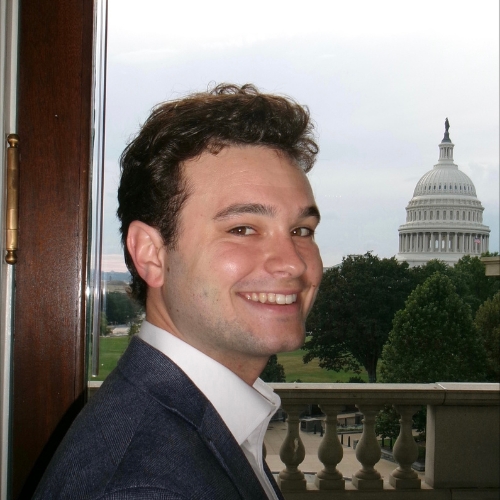
Parker Williams
Undergraduate Institution: University of Richmond, Political Science and Leadership Studies major
Fellowship: American Gas Association
Parker works as a State Affairs Intern with the Government Affairs and Public Policy team at the American Gas Association (AGA), an organization representing more than 200 local energy companies delivering clean natural gas across the United States.
Through this experience, Parker has gained exposure to both federal and state legislative priorities in the energy sector, developed a strong understanding of regulatory and rate case dynamics, and contributed to projects supporting AGA’s advocacy before state commissions and policymakers. He has also had the opportunity to travel and present at national energy policy conferences in Boston, Massachusetts, and Lexington, Kentucky, where he engaged with industry leaders and regulators on issues shaping the nation’s energy landscape.
Parker emphasizes the importance of staying curious, letting your work speak for itself, and building relationships early on. He notes that his coursework at Heinz has been instrumental in connecting data and policy analysis, directly informing his work at AGA.