How Heinz College Graduate Student Dhiksha Rathis Is Applying AI to Performance Engineering at PlayStation
By Amarachi Okafor
 For Dhiksha Rathis, technology has never been just about building something that functions.
A computer science graduate from B.M.S. College of Engineering in Bangalore, India, Rathis came to Carnegie Mellon University's Heinz College to pursue a master's degree in information systems management (business intelligence and data analytics track) because she wanted to understand more than the technology. She wanted to understand the problems technology was being built to solve and the organizations where those solutions ultimately have to work.
“I've always been fascinated by technology for as long as I can remember and I love building things with it. But I've also been really interested in understanding the people behind the problem,” Rathis said. “The better you understand what people need and how they work, the better technology you can build for them.”
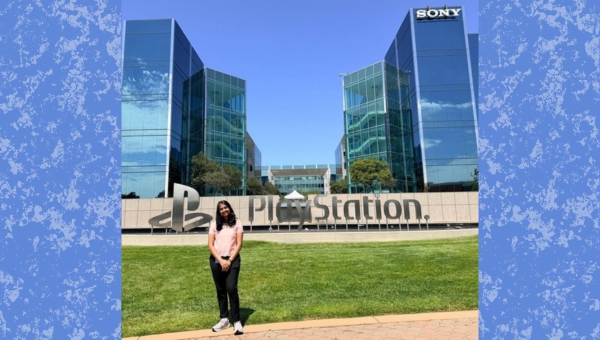
That perspective became especially meaningful this summer, when Rathis joined Sony Interactive Entertainment, the company behind PlayStation, as an AI Engineering intern in San Mateo, California.
There, she was not simply learning how AI is used in industry. She was building something that people would actually use.
Putting AI Knowledge to Work
Building on her Heinz College coursework, Dhiksha Rathis helped turn a weeks-long process into a matter of hours as an AI engineering intern at PlayStation.
Building for a Real Problem
Rathis's primary project focused on an AI-driven performance engineering system. Before her work on the system, onboarding a new service involved significant manual effort and could take more than three weeks.
Rathis helped automate the workflow and introduced validation loops that could verify outputs in real time. The result was a process that could be completed in less than four hours, reducing service onboarding time by approximately 95 percent.
Doing the hands-on work that made such an impact was especially rewarding for Rathis.
“That's something I want to carry forward,” she said. “It's easy to get excited about what technology can do. The harder and more important question is whether you're solving the right problem.”
Learning to Work Beyond the Classroom
The project was only part of the challenge.
Rathis worked across two sister teams with overlapping responsibilities, with a different mentor on each project. At different points during the internship, she was balancing three to four assignments at once, each with different priorities and expectations.
“You have to be comfortable asking questions. Most importantly, you have to be comfortable admitting that you don't have the answer yet,” Rathis said
Her managers encouraged her to sit in on team discussions even when her own work was not on the agenda. Rathis found herself paying attention to conversations about problems she had never worked on, watching how engineers approached tradeoffs and how teams made decisions.
“I loved being in those conversations,” she said. “Sometimes I wasn't directly involved in the problem being discussed, but I could see how people approached it.”
For Rathis, those moments offered a different kind of education. She began to see that engineering goes beyondwriting code or building a system. It is also about understanding the context in which that system must work.
From Heinz College to PlayStation
In Professor Anand Rao's “AI Model Development” course at Heinz College, Rathis learned about an AI architecture concept. The following week, that same topic came up during her PlayStation interview.
“When that question was asked to me,” Rathis said, “I knew it so well because he had taught it the week before.”
It was a small moment, but it stayed with her.
"With a lot of these courses, you don't realize that you're learning so much until you're put on the spot," Rathis said. "Being able to answer that question during the interview is when I realized how much I’d learned."
For Rathis, the moment captured something she valued about her experience at Heinz. The coursework gave her a foundation, but the projects and assignments pushed her to do something with what she was learning.
The professors want students to learn through different projects and assignments that you can apply the knowledge to.Dhiksha Rathis (MISM '26)
“The professors want students to learn through different projects and assignments that you can apply the knowledge to,” she said. “That's very important, because that is what my internship also taught me.”
Looking Beyond the Internship
Rathis describes herself as someone who believes that technology, on its own, is not enough.
“I want to use the skills I have to build things that genuinely make people's lives better,” Rathis said. “Technology is a tool, and I want to spend my career figuring out how to use that tool in ways that actually help people.”
“I don't know exactly what I'll be building years from now,” she said. “But I know I want to keep learning and building. And at the end of it all, I hope I made people's lives a little better.”